
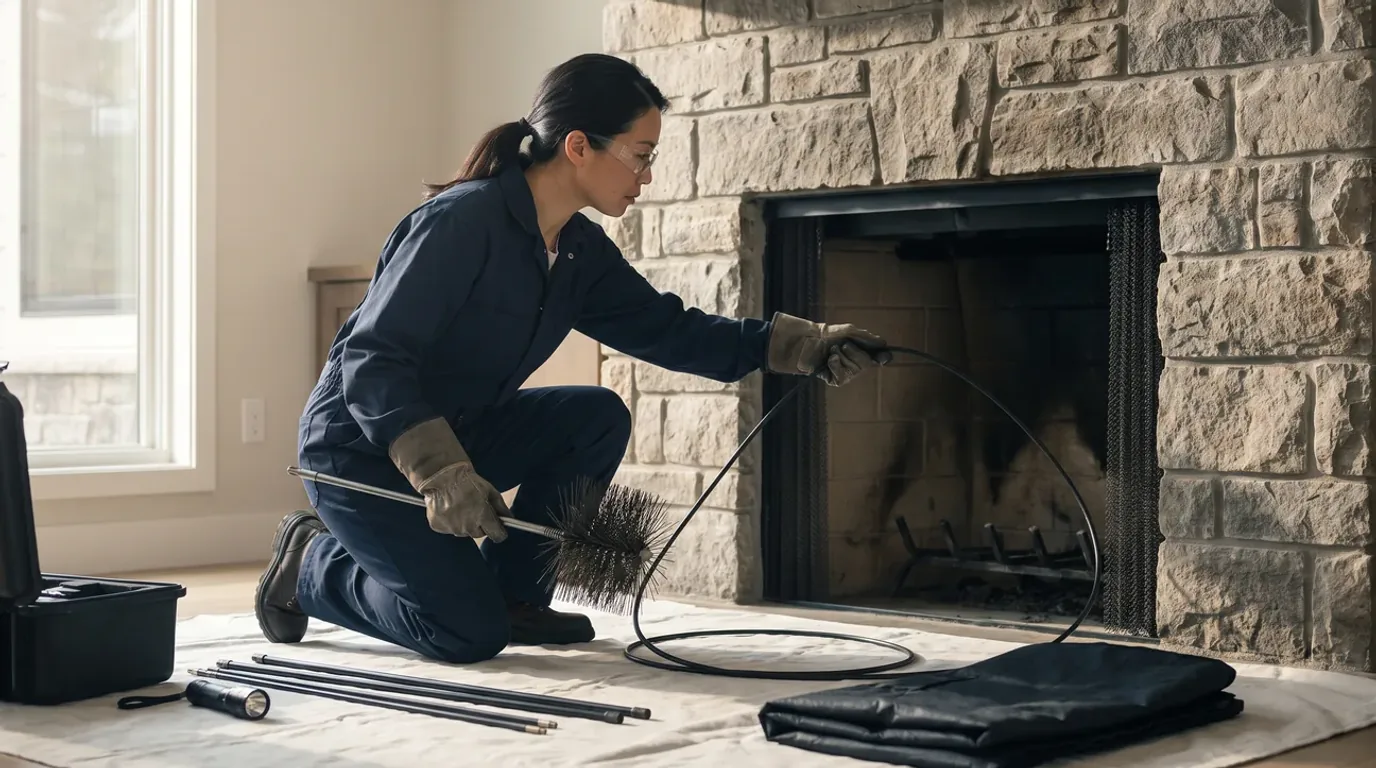
Chimney Cleaning Pricing Guide: Average Rates and How to Price Jobs
Compare 2026 chimney cleaning prices and use crew-hour, visit-cost, inspection, access, buildup, overhead, and margin formulas to build profitable quotes.
Key takeaways:
A profitable chimney-cleaning price starts with a defined inspection and cleaning scope, then recovers access, containment, crew time, equipment, overhead, and a deliberate operating margin.
- Separate inspection from cleaning. State the inspection level, accessible areas, cleaning method, documentation, and exclusions instead of using 'sweep and inspection' as an undefined bundle.
- Price conditions, not only the flue count. Fuel type, appliance, buildup, height, roof pitch, interior access, liners, caps, blockages, and prior events can change the time and equipment required.
- Build a real minimum charge. Travel, setup, floor protection, containment, equipment staging, cleanup, documentation, and payment happen even on a short routine visit.
- Use market ranges as a check. Published consumer and software-company ranges help spot an unusual quote, but they are not a substitute for your labor, overhead, insurance, safety, and margin data.
- Document every add-on before work. Heavy or glazed deposits, extra flues, video inspection, blockages, difficult access, repairs, and destructive access need a clear scope and Customer approval.
A Customer books a “standard sweep.”
The home has two appliances, a steep roof, a long hose route, heavy deposits, and no safe place to stage the equipment described on the phone.
The service name did not change. The job did.
Chimney cleaning prices need enough structure to quote routine work quickly and enough flexibility to handle access, buildup, inspection scope, and safety without improvising at the property.
This guide explains 2026 market benchmarks, inspection levels, pricing models, a crew-hour formula, minimum charges, add-ons, quote examples, safety costs, and a practical Estimate template.
Pro tip from the author: “I define the inspection and cleaning scope before I name the price. ‘Sweep and inspection’ is too vague when access, appliances, flues, documentation, and concealed conditions can be different on every home.”
Quick Answer: How Much Does Chimney Cleaning Cost in 2026?
Current U.S. cost guides place many routine residential chimney-cleaning jobs in the $129 to $400 range, often with a basic or Level 1 inspection included.
- Housecall Pro’s 2026 chimney cleaning pricing guide lists $200 to $400 for a standard residential cleaning and inspection.
- Angi’s July 2026 chimney sweep cost guide reports an average of $254 and a typical range of $129 to $381.
- HomeGuide’s February 2026 chimney sweep cost guide reports an average of $275 and a typical range of $150 to $375.
| Pricing reference | Published 2026 range | Published midpoint or average | Scope note |
|---|---|---|---|
| Housecall Pro | $200 to $400 | Not stated as one national average | Standard residential cleaning and inspection |
| Angi | $129 to $381 | $254 average | Annual cleaning; conditions and location change cost |
| HomeGuide | $150 to $375 | $275 national average | Many ordinary chimney-sweep visits; type and flue count change cost |
These are planning benchmarks, not official rates or a pricing rule. They use different datasets, service definitions, markets, and update methods.
Build your own selling price with:
Selling price = total job cost / (1 - target operating margin)
Total job cost should include loaded labor, travel, setup, interior protection, cleaning supplies, equipment wear, inspection tools, safety controls, overhead, disposal, and other job-specific costs.
Data and Methodology
There is no government database of the prices independent chimney companies charge for residential cleaning.
The market ranges above were reviewed on August 25, 2026 from the current Housecall Pro, Angi, and HomeGuide pages linked in the Quick Answer. They are publisher benchmarks, not a combined statistical sample. We did not average them because their service scopes and methods differ.
The pricing chart later in this article is a GetWorkly editorial scenario. It is not drawn from Customer invoices and is not a recommended national rate.
Safety, inspection, certification, and licensing references come from the U.S. Fire Administration, CDC, OSHA, Chimney Safety Institute of America, NFPA public code-development material, and U.S. Small Business Administration. Local requirements and adopted codes vary. Confirm the rules that apply to the company, employee, property, task, and jurisdiction.
Define the Service Before You Set the Price
“Chimney cleaning” can describe several different scopes.
A routine service may include:
- pre-service questions and visual condition review
- floor and furniture protection
- containment and dust-controlled cleaning
- sweeping one flue serving one appliance
- cleaning accessible firebox, smoke chamber, connector, or appliance areas defined in the scope
- removal of ordinary soot and loose deposits
- a stated level of inspection
- photos or a service report
- cleanup and debris disposal
It may exclude:
- additional flues or appliances
- heavy, glazed, or chemically treated deposits
- animal or nest removal
- caps, liners, dampers, masonry, flashing, crowns, or other repairs
- destructive access
- lift, scaffold, special fall protection, or two-person access needs
- smoke, pressure, camera, or other diagnostic tests beyond the agreed inspection
- permits and third-party reports
Write the inclusion and exclusion list into the price-book item. Otherwise, the technician and Customer may have different definitions of a “standard sweep.”
Chimney Cleaning and Inspection Are Not the Same Scope
Cleaning removes soot, creosote, debris, or obstructions using the method appropriate for the system and condition.
Inspection evaluates accessible parts of the chimney, venting, appliance connection, and related system to the agreed level. A person can clean a flue without completing every element of a higher-level inspection. A person can also inspect a system and determine that cleaning, repair, further evaluation, or no immediate work is appropriate.
The CSIA Level 1 inspection guidance describes Level 1 as the routine level for annual inspections and ordinary cleanings when the system and use have not changed. It covers readily accessible portions of the chimney and accessible portions of the connected appliance and chimney connection.
CSIA’s explanation of the three levels says a Level 2 inspection expands the scope when there is a property transfer, system change, malfunction, or event that may have caused damage. It can include accessible attics, crawl spaces, basements, performance testing, and interior video inspection. A Level 3 inspection is used when a suspected concealed hazard cannot be evaluated without access to concealed areas.
NFPA’s public code-development material for NFPA 211 also distinguishes Level 1, Level 2, and Level 3 scopes. Adopted editions and local requirements can differ, so quote the applicable scope and standard rather than using a level name alone.
| Inspection level | General use | Pricing implication |
|---|---|---|
| Level 1 | Routine evaluation when the system and use are unchanged | Define accessible areas, basic visual work, documentation, and whether cleaning is separate or bundled |
| Level 2 | Change, transfer, malfunction, incident, or condition requiring broader access and evaluation | Add time for additional spaces, camera work, testing, records, and reporting as applicable |
| Level 3 | A suspected concealed hazard cannot be fully evaluated at Levels 1 or 2 | Custom scope, authorization, access plan, restoration responsibility, and separate pricing |
Do not market every camera pass as a complete Level 2 inspection unless the complete required scope is performed and documented.
Choose the Right Chimney Cleaning Pricing Model
Most companies use a flat price for predictable routine work and custom or crew-hour pricing for uncertain conditions.
Flat Rate Per System or Flue
Flat-rate pricing works when the company can define a repeatable service.
Example price-book items:
- one wood-burning fireplace, one flue, ordinary buildup, routine inspection scope
- one prefabricated fireplace and listed chimney system
- one wood or pellet stove with a defined connector length
- gas-appliance vent inspection with the specified cleaning scope
- additional flue during the same visit
Define what counts as one system. Two fireplaces may share a masonry structure but use separate flues, appliances, access points, and cleaning setups.
Flat Rate Plus Condition Add-Ons
This model keeps a clear base price and adds predefined charges for:
- additional flue or appliance
- heavy deposit tier
- difficult roof or interior access
- video inspection
- nest or blockage removal where lawful and safe
- after-hours service
- special containment
- lift or scaffold
- written report beyond the standard service record
Every add-on should connect to added time, cost, equipment, documentation, or risk.
Crew-Hour Pricing
Crew-hour pricing protects work that cannot be scoped reliably before inspection.
One crew-hour means one worker for one hour:
- one worker for three hours = three crew-hours
- two workers for two hours = four crew-hours
- three workers for two hours = six crew-hours
Use crew-hours internally for heavy deposits, unusual appliances, extensive connectors, difficult access, large commercial systems, investigative work, or restoration preparation. You can still present a fixed price after the site assessment.
Time and Materials
Time and materials can fit emergency, investigative, or repair work when the final scope cannot be known in advance.
Put the labor rate, minimum time, material treatment, equipment charges, authorization limit, documentation, and stop-work process in writing. Obtain approval before exceeding the limit.
Recurring Service Pricing
An annual program can reduce selling and setup costs when the company has:
- saved system records
- known access
- predictable service timing
- route density
- lighter routine conditions
- consistent Customer communication
Do not discount future work that has not been scheduled or contracted. Define frequency, scope, exclusions, access, cancellation, and annual price review.
Calculate Loaded Labor and Overhead
Start with the cost of employing or compensating the technician, not the hourly wage alone.
Loaded labor may include:
- wage or owner labor target
- employer payroll taxes
- workers’ compensation
- paid leave and benefits
- training and certification time
- uniforms and ordinary protective equipment
Then allocate overhead using realistic billable crew-hours.
Chimney-service overhead can include:
- general liability, vehicle, and other insurance
- trucks, fuel, maintenance, and storage
- vacuums, filters, rods, brushes, cameras, lighting, ladders, and access equipment
- inspection, containment, and reporting tools
- certifications, licensing, and continuing education
- phones, software, bookkeeping, banking, and payment costs
- marketing, estimates, callbacks, and unbillable travel
- office, shop, utilities, and professional fees
Use:
Overhead per billable crew-hour = monthly overhead / realistic monthly billable crew-hours
If the company pays for 320 crew-hours but sells only 210 after travel, setup, training, weather, estimates, and admin, divide overhead by 210. Dividing by every paid hour understates job cost.
Illustrative Minimum Price by Crew-Hours
The chart uses a transparent service-business scenario:
- loaded labor: $36 per crew-hour
- overhead allocation: $28 per crew-hour
- fixed visit, equipment, and consumable cost: $55
- target operating margin: 25%
The formula is:
Minimum price = ((crew-hours x $64) + $55) / 0.75
The same calculation is available below for accessibility.
| Crew-hours | Crew-hour cost | Fixed visit cost | Total cost | Price at 25% margin |
|---|---|---|---|---|
| 2 | $128 | $55 | $183 | $244 |
| 3 | $192 | $55 | $247 | $329 |
| 4 | $256 | $55 | $311 | $415 |
| 5 | $320 | $55 | $375 | $500 |
| 6 | $384 | $55 | $439 | $585 |
This is a GetWorkly editorial scenario, not a market average or recommended rate. Replace every input with the company’s actual labor, overhead, visit cost, and margin target.
Notice how quickly a flat $250 price fails when a job requires two technicians or several hours of access, containment, inspection, cleaning, and documentation.
Set a Minimum Service Charge
Even a short routine visit can require:
- scheduling and pre-arrival communication
- driving and parking
- equipment unloading and staging
- property and floor protection
- containment setup
- inspection and photos
- cleaning and vacuum handling
- equipment cleaning and packing
- Customer explanation, report, payment, and travel to the next job
Use:
Minimum service price = minimum visit cost / (1 - target operating margin)
Suppose the smallest safe, defined visit costs:
- two crew-hours of loaded labor and overhead: $128
- vehicle, consumables, and equipment allocation: $55
- total cost: $183
At a 25% target operating margin:
$183 / 0.75 = $244
The company might set a $245 or $250 minimum, then define exactly what it includes.
Do not force a complex system into the minimum. Use the inspection or assessment to present a revised scope when actual conditions fall outside the base item.
Factors That Change Chimney Cleaning Prices
Number of Flues and Appliances
Each flue and appliance may require separate access, brushing, inspection, setup, and documentation.
Ask at booking:
- how many fireplaces, stoves, inserts, or connected appliances are present
- whether each appliance has its own flue
- fuel type
- approximate age and last service date
- whether the system has changed
Fuel and Appliance Type
Wood-burning fireplaces, wood stoves, pellet stoves, inserts, gas appliances, and oil-fired systems create different deposits and service requirements.
Do not use one method or price merely because each connects to a chimney. Follow appliance and chimney manufacturer instructions, applicable codes, company training, and the confirmed service scope.
Deposit Type and Severity
Light soot and loose creosote are different from heavy, hardened, or glazed deposits.
Create condition tiers with objective descriptions, photos, expected methods, and authorization rules. When specialized removal is recommended, explain whether the service reduces deposits, whether further inspection is needed, and what result can or cannot be promised.
Height, Roof Pitch, and Access
Access can change crew size, setup time, equipment, and exposure.
Record:
- story count and roof pitch
- ladder placement and ground condition
- chimney location relative to the roof edge
- exterior obstacles and power lines
- interior access and floor route
- attic, crawlspace, or basement access required by the inspection scope
- whether a lift, scaffold, or additional worker is needed
OSHA’s residential fall-protection resources link the applicable construction standards for fall protection, scaffolds, stairs, and ladders. The exact requirements depend on the work and employer. Price the compliant access plan instead of treating it as free setup.
Interior Protection and Containment
Dust control is part of the service.
Price time and materials for:
- floor covers and barriers
- furniture movement or Customer preparation
- sealing and containment
- vacuum filters and bags
- cleaning tools between jobs
- debris packaging and disposal
- final cleanup
A clean living room is not a bonus. It is part of a professionally defined chimney-cleaning scope.
Inspection and Documentation
Add time for:
- camera setup and review
- accessible attic, crawlspace, basement, or rooftop areas within scope
- photos, diagrams, and written observations
- property-transfer or incident documentation
- communication with an owner, buyer, manager, insurer, or other party
- follow-up recommendations
Do not bundle a detailed Level 2 or Level 3 service into a routine cleaning price without estimating the full work.
Blockages, Animals, and Nests
Blockages may require more investigation and a different work plan.
Wildlife laws, seasons, permits, and removal rules can apply. Confirm the species and local requirements instead of promising immediate removal during booking. Repairs that prevent re-entry should be a separate approved scope.
Repairs and Destructive Access
Caps, liners, crowns, masonry, flashing, dampers, smoke chambers, connectors, and appliances are repair scopes, not automatic cleaning add-ons.
If a Level 3 inspection or repair requires removing building material, obtain written authorization that defines:
- exact access area
- who opens and restores it
- dust and property protection
- permits and inspections
- price or time-and-material limit
- hidden-condition process
Build a Chimney Cleaning Price Book
A usable price book can include:
| Item | Unit | Scope control |
|---|---|---|
| Standard one-flue sweep | Per system | Defined appliance, ordinary buildup, accessible route, protection, cleaning, and inspection scope |
| Additional flue | Each during same visit | Separate flue with ordinary condition and shared travel/setup |
| Wood or pellet stove connector | Length or complexity tier | Accessible connector and appliance-specific procedure |
| Level 2 inspection | Per system | Defined accessible areas, camera work, testing if applicable, photos, and report |
| Heavy deposit removal | Condition tier or crew-hour | Approved after inspection with method and outcome limits |
| Nest or blockage assessment | Per system | Investigation only until species, legality, and removal scope are confirmed |
| Difficult access | Tier or crew-hour | Extra setup, crew, ladder, lift, scaffold, or fall-protection requirement |
| Cap or minor repair | Each | Separate material, labor, access, warranty, and permit terms |
| Detailed report | Each | Documentation beyond the standard service record |
Every item should have an internal effective date, cost, expected crew-hours, Customer description, inclusions, exclusions, tax treatment, and approval rule.
Review the price book when labor, insurance, vehicle, equipment, filter, fuel, certification, or disposal costs change materially.
Three Chimney Cleaning Quote Examples
These are editorial examples. They show the method, not a recommended price.
Example 1: Routine One-Flue Service
Scope: One wood-burning fireplace and one flue, ordinary buildup, normal interior access, routine inspection scope, floor protection, cleaning, photos, and cleanup.
Estimated cost:
- three crew-hours at $64 labor plus overhead: $192
- fixed visit and equipment cost: $55
- total cost: $247
- target margin: 25%
Price:
$247 / 0.75 = $329.33
The company might present a flat price of $329 or $330 with clear condition limits.
Example 2: Two Flues With Video Inspection
Scope: Two flues serving separate appliances, broader accessible-area review, internal camera work, photos, report, ordinary deposits, and moderate access.
Estimated cost:
- six crew-hours at $64: $384
- fixed visit and equipment cost: $55
- camera/report allocation: $45
- total cost: $484
- target margin: 28%
Price:
$484 / 0.72 = $672.22
The company might quote $675, subject to a written definition of inspection level and exclusions.
Example 3: Heavy Deposits and Difficult Roof Access
Initial scope: Assessment, routine accessible inspection, property protection, and standard cleaning attempt within a defined limit.
The technician documents deposits and access conditions that fall outside the base service. The Customer receives a change proposal before specialized work begins.
Additional scope:
- four extra crew-hours: $256
- special consumables and equipment wear: $65
- additional containment and disposal: $30
- incremental cost: $351
- target margin: 30%
Additional price:
$351 / 0.70 = $501.43
The final Estimate should state the method, authorization limit, expected result, and whether another inspection is required.
Safety and Compliance Costs Belong in the Estimate
Safety is not a percentage added after the quote. It changes the work method, crew, equipment, time, and insurance behind the price.
The U.S. Fire Administration recommends that homeowners have heating equipment and chimneys cleaned and inspected each year by a professional. The CDC also says chimneys should be checked or cleaned every year because debris can block venting and allow carbon monoxide to build up.
Those public-safety recommendations explain the value of the service. They do not define the contractor’s exact cleaning method or replace inspection judgment.
For the business, price and document applicable controls for:
- ladders, roof access, fall protection, scaffolds, or lifts
- equipment inspection and training
- dust containment and vacuum filtration
- respiratory-hazard evaluation and required protection
- electrical, combustion, heat, and sharp-edge hazards
- animal, mold, asbestos, silica, lead, or other suspect materials
- occupied-home communication and exclusion zones
- waste packaging and disposal
Do not make a universal PPE claim from a blog article. The employer must evaluate the task and follow applicable OSHA, state-plan, manufacturer, and local requirements.
Certification, Licensing, and Insurance
The Chimney Safety Institute of America certification page describes the CSIA Certified Chimney Sweep credential as an industry certification based on chimney and venting knowledge. Its Certified Sweep pathway requires a review process and exam, with a three-year certification cycle.
Certification is not automatically the same as a state or local government license.
The U.S. Small Business Administration explains that licenses and permits depend on business activity and location. Check state, county, and city requirements for:
- general business registration
- home-improvement or contractor licensing
- specialty work such as masonry, gas, HVAC, roofing, or appliance connection
- sales tax and payroll registration
- wildlife handling
- permits and inspections
- vehicle and waste rules
Also confirm with the insurance broker that general liability, workers’ compensation, commercial auto, roof work, inspection work, repairs, and subcontractors match the actual services offered.
Build certification, renewal, insurance, licensing, and training into overhead or a dedicated cost pool. Do not leave them to the owner’s unpaid time.
Write a Clear Chimney Cleaning Estimate
A strong Estimate answers these questions:
What System Is Being Serviced?
Identify:
- property and service location
- appliance and fuel type
- number of flues
- accessible connectors and components
- known manufacturer or listing information where relevant
- prior service date and reported events
What Is Included?
State:
- inspection level and accessible areas
- cleaning method and ordinary condition limit
- floor protection and containment
- photo or report deliverables
- cleanup and disposal
- Customer preparation and access responsibility
What Is Excluded?
Common exclusions include:
- concealed conditions
- code-compliance certification unless specifically contracted
- destructive access
- heavy or glazed deposit removal beyond the stated tier
- wildlife removal
- repairs and replacement parts
- lift, scaffold, or specialty access not visible at booking
- third-party testing, permits, and restoration
What Can Change the Price?
List objective change triggers:
- additional flue or appliance
- condition above the base buildup tier
- unsafe or materially different access
- blockage or animal activity
- broader inspection required by conditions or event history
- Customer-requested report or repair
State that added work requires Customer approval before proceeding, except for immediate actions needed to leave the property safe under the company’s policy and agreement.
What Are the Commercial Terms?
Include:
- total price or rate and limit
- tax treatment
- Deposit if applicable
- payment methods and due date
- cancellation and rescheduling policy
- Estimate expiration
- warranty or result limitations
- authorization and signature
Explain the Price to the Customer
Lead with the defined outcome, not a list of surcharges.
Example:
“The base service covers one flue and appliance, routine accessible inspection, floor protection, dust-controlled cleaning for ordinary deposits, photos, cleanup, and a written service record. If we find a second flue, heavy deposits, a blockage, or access that requires a different work plan, we will document it and give you the price before additional work starts.”
This language makes the base price clear and protects the Customer from surprise work.
Avoid saying the chimney is “certified safe” unless the company has a defined, supportable service and authority for that exact statement. Describe what was observed, what was not accessible, what work was performed, and what further action is recommended.
Common Chimney Cleaning Pricing Mistakes
Copying the Local Lowest Price
Another company may have different insurance, crew pay, equipment, service scope, inspection level, overhead, route density, and margin.
Use market ranges as a reasonableness check, then price your defined service from cost.
Bundling an Undefined “Free Inspection”
Inspection takes time, training, tools, access, judgment, documentation, and liability.
Define the level and include its cost in the bundle, or price it separately.
Charging Only for Brush Time
Travel, protection, containment, setup, equipment cleaning, reporting, payment, and disposal can exceed the brushing time on a routine visit.
Track the full arrival-to-departure crew-hours.
Treating Every Deposit Condition the Same
Ordinary soot, loose creosote, hardened deposits, glazed deposits, and blockages can require different methods and time.
Use condition tiers and approval rules.
Ignoring Access During Booking
Ask for story count, roof pitch, chimney location, interior route, appliance photos, parking, and prior service information. Explain that the final scope depends on site verification.
Mixing Repairs Into the Cleaning Invoice
Repairs need their own diagnosis, material, labor, warranty, permit, and authorization. Separate them so the Customer can see what was cleaned, what was observed, and what is proposed.
Chimney Cleaning Pricing Checklist
Before sending the Estimate, confirm:
- Appliance, fuel, flue count, and service location are identified
- Inspection level and accessible areas are defined
- Ordinary cleaning condition and buildup limits are written
- Interior protection, containment, cleanup, and documentation are included
- Access, roof, crew, and equipment needs are priced
- Loaded labor, overhead, visit cost, and margin are calculated
- Additional flues, deposits, blockages, wildlife, and repairs have approval rules
- Licenses, certification, insurance, and safety costs are accounted for
- Customer preparation, exclusions, payment, cancellation, and expiration are clear
- The final approved scope will flow into the job record and Invoice
Frequently Asked Questions
How Much Should a Chimney Sweep Charge?
Current 2026 publisher ranges place many routine residential jobs between $129 and $400, but the correct company price depends on defined scope, flues, appliances, buildup, access, crew-hours, inspection level, overhead, and margin. Calculate the price from cost, then compare it with current local benchmarks.
Should Chimney Cleaning Include an Inspection?
Many companies bundle a routine inspection with cleaning, but the Estimate should state the level and accessible areas. Cleaning and inspection are different activities. A Level 2 or Level 3 inspection has a broader scope and should not be implied by a generic bundle.
How Much Should I Charge for an Additional Flue?
Calculate the incremental crew time, separate access or equipment, inspection, cleaning, documentation, and margin. An additional flue may share travel and some setup, but it is not automatically a quick add-on.
Should Chimney Sweeps Charge Flat Rate or Hourly?
Flat pricing works for a defined routine service with ordinary conditions. Crew-hour or time-and-material pricing can protect uncertain, investigative, heavy-deposit, access-intensive, commercial, or repair work. Many companies use a flat base plus approved condition add-ons.
What Is the Difference Between Markup and Margin?
Markup is profit added to cost. Margin is profit as a percentage of the selling price. To target a 25% margin, divide cost by 0.75. Adding 25% to cost creates a 20% margin.
Is CSIA Certification a License?
No, not by itself. CSIA certification is an industry credential. Government license and permit requirements depend on location and work type. Check state and local agencies, especially when services include masonry, roofing, gas, HVAC, appliance, structural, or wildlife work.
How Often Should a Chimney Be Cleaned?
Public safety agencies recommend annual professional inspection or checking, with cleaning as needed or as recommended for the system and use. The U.S. Fire Administration and CDC both publish annual chimney-maintenance guidance. The specific cleaning frequency depends on fuel, use, system, deposits, manufacturer instructions, inspection findings, and applicable code.
Price the Complete Service
A chimney-cleaning price should recover more than the time a brush is inside the flue.
It should recover the complete professional service: travel, setup, property protection, containment, access, inspection, cleaning, equipment, documentation, compliance, cleanup, and a sustainable operating margin.
Define the inspection level. Build a minimum charge. Use condition tiers. Require approval for extra work. Review actual crew-hours and gross profit after every job.
Then use the approved Estimate as the operational record. Workly helps service Pros move from AI-assisted Estimates through signatures, Deposits, scheduling, Invoices, and payment in one phone-first workflow.