
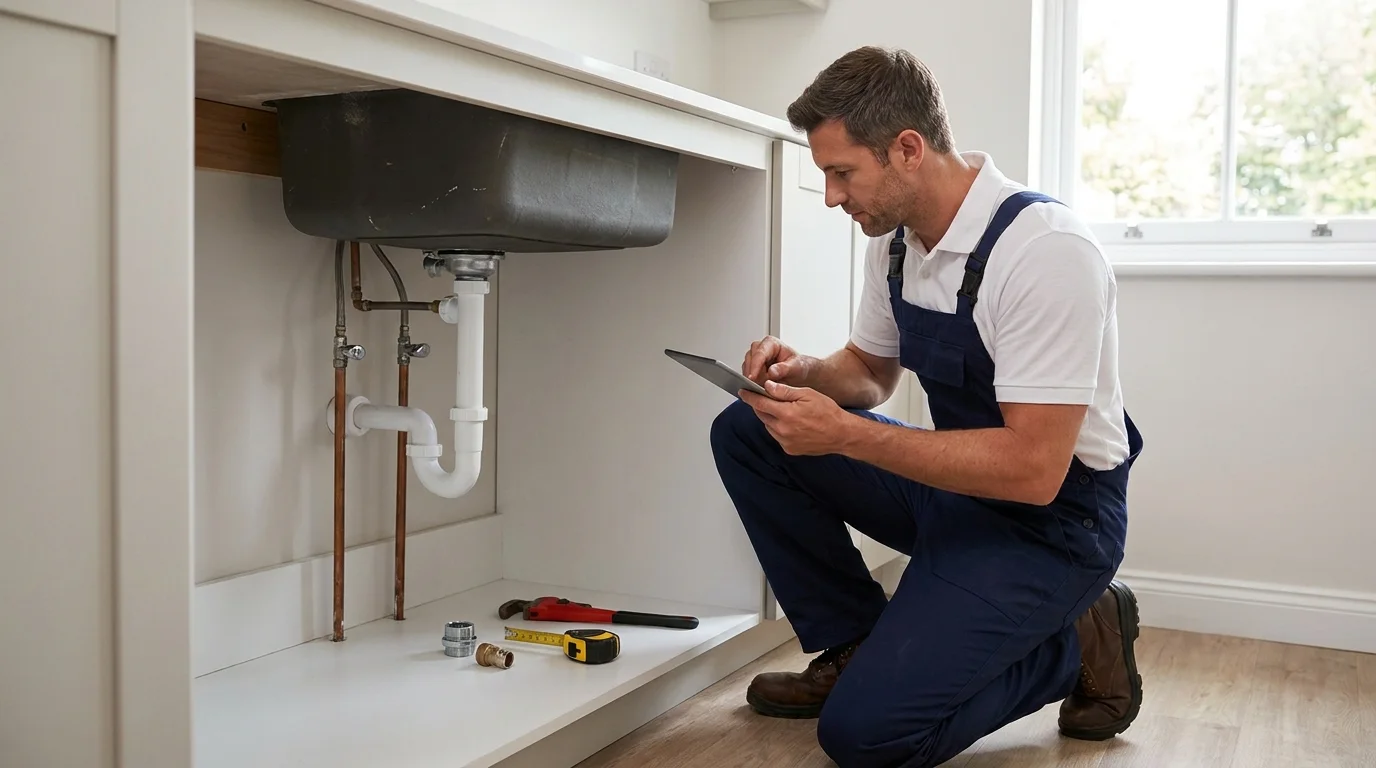
Plumbing Pricing Guide 2026: Average Rates and How to Price Jobs Profitably
Learn average plumbing rates in 2026, how to price plumbing jobs, and simple formulas with examples for building profitable estimates.
Key takeaways:
Plumbing prices need to cover the technician, vehicle, tools, overhead, job risk, and profit, not only the visible repair time.
- Start with the complete job cost. Combine loaded labor, materials, overhead, travel, equipment, permits, disposal, and other direct expenses.
- Choose the pricing method by uncertainty. Hourly pricing protects unpredictable diagnostics, while flat-rate pricing works well for repeatable services with known production data.
- Use modifiers for real job conditions. Access, urgency, contamination, after-hours work, old systems, and commercial requirements can change labor and risk.
- Maintain a price book from completed jobs. Update labor assumptions, material costs, standard tasks, and options using actual field results.
- Track gross profit by service. A busy schedule can still lose money if estimates repeatedly miss labor, overhead, callbacks, or material changes.
A plumbing job can look easy when the customer explains it over the phone.
“It is just a small leak.”
Then the tech gets there and finds a stuck shutoff valve, old fittings, bad access, and a customer who wants it fixed before dinner.
That is where weak pricing hurts.
If the estimate only covers the easy version of the job, the business pays for the hard version. The schedule gets squeezed, the tech gets rushed, and the profit disappears.
This plumbing pricing guide for 2026 explains average rates, common job prices, and a simple way to calculate estimates that actually protect your margin.
Pro tip from the author: “I do not build prices around the best-case job. I build them around the job that usually happens in the real world, with enough room for small surprises.”
Quick Answer: Plumbing Rates in 2026
According to Housecall Pro’s 2026 plumbing pricing guide, most residential plumbing work falls around $80 to $130 per hour. Commercial plumbing often starts around $100 to $150 per hour, and emergency calls can reach $150 to $300 per hour.
Here is a quick pricing snapshot:
| Plumbing work | Typical 2026 rate |
|---|---|
| Apprentice plumber | $45 to $70 per hour |
| Journeyman plumber | $80 to $130 per hour |
| Master plumber | $120 to $200 per hour |
| Commercial plumbing | $100 to $150+ per hour |
| Emergency plumbing | $150 to $300 per hour |
| Service call or diagnostic fee | $50 to $250 |
These numbers are helpful, but they are not the whole answer.
The right price depends on your labor cost, material cost, overhead, local market, job difficulty, and profit target.
Use this simple formula:
Final plumbing price = labor + materials + overhead + service fee + modifiers + profit
That formula keeps you from guessing.
Why Plumbing Pricing Is Harder Than It Looks
Most plumbers are good at spotting the repair.
Pricing the repair is a different skill.
A toilet repair may take 30 minutes in a newer home. The same repair may take two hours in an older house if the bolts are rusted, the shutoff valve leaks, and the customer wants the supply line replaced too.
The job title is the same. The cost is not.
That is why plumbing pricing should account for:
- time on site
- travel time
- technician wages
- payroll taxes and benefits
- parts and small materials
- vehicle and fuel costs
- insurance and licenses
- admin time
- cleanup and disposal
- permits when needed
- profit
If your price only includes labor and the main part, you are leaving out a big part of the real cost.
Pro tip from the author: “When I see a plumbing estimate that feels too low, the missing number is usually overhead. The business remembered the pipe and forgot the cost of staying in business.”
Average Plumbing Price List for 2026
Customers often search online before they call. They may see a low number and expect every plumber to match it.
That is why it helps to know common price ranges before you explain your quote.
Small Plumbing Jobs
| Job | Typical price range | Why the price changes |
|---|---|---|
| Faucet or fixture installation | $150 to $535 | brand, access, old parts, shutoff condition |
| Toilet repair | $100 to $250 | parts, clog severity, rusted bolts |
| Drain clearing | $125 to $300 | blockage depth, pipe length, equipment |
| Minor leak repair | $150 to $400 | access, pipe type, fittings needed |
| Garbage disposal installation | $200 to $450 | electrical access, unit type, removal |
Example:
A simple faucet swap may be close to $200 if the faucet is ready, the shutoffs work, and the cabinet is easy to reach.
But if the shutoff valve fails and the supply lines need replacing, that is no longer the same job. The price should move up because the labor and risk changed.
Large Plumbing Jobs
| Job | Typical price range | Why the price changes |
|---|---|---|
| Water heater replacement | $1,600 to $7,000 | tank type, tankless upgrade, permits, venting |
| Main water line repair | $400 to $5,000 | depth, digging, pipe material |
| Whole-home repipe | $4,000 to $15,000 | home size, access, pipe choice |
| Sewer line replacement | $3,000 to $10,000 | excavation, permits, line length |
| Commercial plumbing installation | $5,000 to $50,000 | project size, code needs, materials |
Large jobs need a tighter estimate because the mistakes are more expensive.
A water heater replacement is not just a water heater. You may need fittings, disposal, permit work, venting updates, a drain pan, an expansion tank, and extra time if access is tight.
If those items are not in the quote, they come out of your margin.
Emergency Plumbing Services
Emergency plumbing should not be priced like a normal service call.
When a customer calls at night, on a weekend, or during a holiday, they are not only paying for the repair. They are paying for fast response, schedule disruption, and the cost of keeping someone available.
Typical emergency plumbing rates in 2026 include:
| Emergency service | Typical price range |
|---|---|
| Emergency service call | $150 to $350+ before repair cost |
| After-hours repair | 1.5 to 3 times the standard rate |
| Weekend or holiday repair | 1.5 to 3 times the standard rate |
| Emergency hourly rate | $150 to $300 per hour |
Use this formula for emergency calls:
Emergency price = standard job price x emergency multiplier
Example:
A normal drain cleaning is $250 during business hours.
If the customer needs the same service after hours and your emergency multiplier is 1.5:
$250 x 1.5 = $375
If the call happens on a holiday and your multiplier is 2:
$250 x 2 = $500
You can also use an emergency service fee plus the repair price.
Example:
- Emergency service fee: $175
- Repair labor: 2 hours at $185 per hour
- Materials: $65
Calculation:
$175 + ($185 x 2) + $65 = $610
Suggested quote:
$610 to $625
Emergency pricing should be clear before the technician arrives. Tell the customer the service fee, hourly rate or flat rate, and when the clock starts.
Pro tip from the author: “I like to explain emergency pricing upfront. It prevents awkward conversations later, and it helps customers understand that the extra cost is tied to speed and availability.”
Hourly Pricing vs Flat-Rate Pricing
There is no single best pricing model for every plumbing job.
Hourly pricing works best when the scope is unclear. Leak detection, slab problems, old pipe repairs, and diagnostic work often fit this model because the job can change once the wall, floor, or crawlspace is opened.
Flat-rate pricing works best for repeatable jobs. Drain clearing, toilet repairs, faucet installs, and garbage disposal installs are easier to package because you can estimate the labor and materials ahead of time.
Many plumbing businesses use both.
Use hourly pricing when the work is unpredictable.
Use flat-rate pricing when the scope is familiar.
Pro tip from the author: “I like flat-rate pricing for common jobs because customers understand it quickly. But I only trust flat rates when they are built from real costs, not from what another company happens to charge.”
The Core Plumbing Pricing Formula
Use this formula when building any plumbing estimate:
Final price = labor cost + material cost + overhead cost + service fee + job modifiers + profit
Here is the plain-English version:
What it costs you + what makes the job harder + the profit you need = what you charge
Each part matters.
Labor cost is the true cost of the technician’s time.
Material cost includes parts, fittings, pipe, tape, sealant, valves, disposal materials, and small items that are easy to forget.
Overhead cost includes the business expenses that keep the company running, such as insurance, fuel, software, tools, vehicles, phones, licenses, rent, marketing, and office help.
Service fee covers the cost of showing up, diagnosing the issue, and reserving time on the schedule.
Job modifiers cover difficulty, urgency, access, permits, special equipment, and risk.
Profit is what remains after costs. Without it, the business is only staying busy.
Formula 1: True Labor Cost
Do not price labor from wages alone.
A plumber who earns $35 per hour may cost the business more than $35 once taxes, benefits, paid time, and insurance are included.
Use this formula:
True labor cost = hourly wage + payroll taxes + benefits + other labor costs
Example:
- Hourly wage: $35
- Payroll taxes: $3.50
- Benefits: $5.25
Calculation:
$35 + $3.50 + $5.25 = $43.75 per hour
So the true labor cost is $43.75 per hour.
If the job takes 2 hours:
$43.75 x 2 = $87.50
That is your labor cost before overhead, materials, and profit.
Formula 2: Overhead Rate
Overhead is the part of pricing that gets ignored most often.
If your company has trucks, insurance, software, phones, tools, licenses, and fuel, those costs need to be included somewhere. The cleanest way is to spread overhead across billable hours.
Use this formula:
Overhead rate = annual overhead divided by annual billable hours
Example:
- Annual overhead: $120,000
- Annual billable hours: 2,000
Calculation:
$120,000 divided by 2,000 = $60 per billable hour
If a job takes 2 hours:
$60 x 2 = $120 in overhead
Pro tip from the author: “Once I know the overhead rate, pricing gets much clearer. I can see the cost of every hour, not just the wage paid to the plumber.”
Formula 3: Base Job Cost
Base job cost tells you what the job costs before profit.
Use this formula:
Base job cost = labor + materials + overhead + service fee
Example:
A faucet replacement is expected to take 1.5 hours.
- True labor cost: $43.75 per hour
- Labor time: 1.5 hours
- Overhead rate: $60 per hour
- Materials: $75
- Service fee: $75
Labor:
$43.75 x 1.5 = $65.63
Overhead:
$60 x 1.5 = $90
Base job cost:
$65.63 + $90 + $75 + $75 = $305.63
This means the job costs about $306 before profit.
If you quote $300, the job is already too tight.
Formula 4: Profit Margin
Profit is not a bonus. It is what lets the business replace equipment, hire better help, handle slow weeks, and keep growing.
Many plumbing businesses aim for 10% to 30% profit per job, depending on the work.
Use this formula:
Final price = base job cost x profit multiplier
Use these multipliers:
| Profit target | Multiplier |
|---|---|
| 10% | 1.10 |
| 15% | 1.15 |
| 20% | 1.20 |
| 25% | 1.25 |
| 30% | 1.30 |
Using the faucet example:
- Base job cost: $305.63
- Profit target: 20%
- Multiplier: 1.20
Calculation:
$305.63 x 1.20 = $366.76
Suggested quote:
$369 to $375
That quote is much stronger than a guessed $300 because it includes the full cost of the job.
Formula 5: Job Modifiers
Some jobs deserve a higher price because they take more effort, carry more risk, or disrupt the schedule.
Use modifiers when the job includes:
- crawlspace work
- attic work
- slab work
- corroded or old plumbing
- premium materials
- permits
- excavation
- special equipment
- emergency response
- after-hours scheduling
Common modifier examples:
| Situation | Suggested adjustment |
|---|---|
| Hard access | Add 10% to 20% |
| Premium materials | Add 5% to 10% |
| Permits or special equipment | Add 10% to 15% |
| After-hours work | Charge 1.5 to 3 times the normal rate |
Example:
A normal drain cleaning is $250.
The customer calls at night and needs immediate service. Your emergency multiplier is 1.5.
$250 x 1.5 = $375
If it is a holiday call and you use a 2 times multiplier:
$250 x 2 = $500
That price reflects response time, schedule disruption, and the cost of being available.
Pro tip from the author: “I do not apologize for emergency rates. The customer is paying for the repair, but they are also paying for speed.”
Example 1: Toilet Repair Estimate
Scenario:
A customer has a running toilet. The likely fix is a new fill valve and flapper.
Costs:
- Labor time: 1 hour
- True labor cost: $43.75 per hour
- Overhead rate: $60 per hour
- Parts: $35
- Service fee: $75
- Profit target: 20%
Base job cost:
$43.75 + $60 + $35 + $75 = $213.75
Add profit:
$213.75 x 1.20 = $256.50
Suggested quote:
$255 to $265
If the shutoff valve leaks or the toilet bolts are badly rusted, the price should increase before the extra work starts.
Example 2: Faucet Replacement Estimate
Scenario:
A homeowner wants a bathroom faucet replaced. The faucet is already purchased, but the supply lines are old.
Costs:
- Labor time: 1.5 hours
- True labor cost: $43.75 per hour
- Overhead rate: $60 per hour
- Materials: $95
- Service fee: $75
- Profit target: 20%
Labor:
$43.75 x 1.5 = $65.63
Overhead:
$60 x 1.5 = $90
Base job cost:
$65.63 + $90 + $95 + $75 = $325.63
Add profit:
$325.63 x 1.20 = $390.76
Suggested quote:
$389 to $399
This is a good example of why two faucet jobs should not always have the same price.
Example 3: Water Heater Replacement Estimate
Scenario:
A customer needs a standard tank water heater replacement.
Costs:
- Labor time: 4 hours
- True labor cost: $43.75 per hour
- Overhead rate: $60 per hour
- Water heater and materials: $1,250
- Permit and disposal: $175
- Service fee: $75
- Profit target: 25%
Labor:
$43.75 x 4 = $175
Overhead:
$60 x 4 = $240
Base job cost:
$175 + $240 + $1,250 + $175 + $75 = $1,915
Add profit:
$1,915 x 1.25 = $2,393.75
Suggested quote:
$2,395 to $2,450
If the job needs venting updates, code corrections, tight access work, or a tankless upgrade, add those costs before giving the final quote.
Example 4: Commercial Plumbing Repair
Scenario:
A small restaurant has a sink issue and needs same-day repair.
Costs:
- Commercial rate: $145 per hour
- Labor time: 3 hours
- Materials: $180
- Service fee: $125
- Same-day urgency modifier: 10%
Labor billed:
$145 x 3 = $435
Base price:
$435 + $180 + $125 = $740
Add urgency modifier:
$740 x 1.10 = $814
Suggested quote:
$815 to $825
Commercial repairs often affect the customer’s ability to operate. If a restaurant sink is down, the issue is bigger than plumbing. It can affect staff, service, and inspections.
How to Build a Plumbing Price Book
A price book helps you stop rebuilding every estimate from scratch.
Start with the jobs you do most often:
- drain clearing
- toilet repair
- faucet installation
- leak repair
- garbage disposal installation
- water heater replacement
- shutoff valve replacement
- sump pump replacement
- hose bib repair
For each service, write down:
- expected labor time
- true labor cost
- material allowance
- overhead cost
- service fee
- profit target
- final flat rate
- notes for modifiers
Example price book entry:
| Item | Value |
|---|---|
| Service | Faucet replacement |
| Expected labor | 1.5 hours |
| Materials allowance | $95 |
| Service fee | $75 |
| Base cost | $325.63 |
| Profit target | 20% |
| Suggested flat rate | $399 |
| Modifier note | Add 10% to 20% for bad access, failed shutoffs, or corroded parts |
Pro tip from the author: “I like price books because they keep pricing consistent. The customer gets a clear number, and the tech is not forced to invent a price in the driveway.”
Common Plumbing Pricing Mistakes
Most pricing mistakes happen before the wrench comes out.
Avoid these:
- copying competitor prices without knowing their costs
- skipping the diagnostic fee
- forgetting travel time
- leaving out overhead
- using old material prices
- pricing emergency calls like normal calls
- giving flat rates without a clear scope
- discounting before checking margin
- ignoring bad access
- failing to review prices every quarter
A discount can still make sense, but only if the job remains profitable.
If a customer wants a lower price, adjust the scope instead of cutting blindly. For example, offer a basic repair option and a better long-term repair option.
Pro tip from the author: “If I lower a price, I want to know exactly what changed. I do not cut profit just because the customer asked.”
How Often Should You Update Plumbing Prices?
Review your prices at least quarterly.
That does not mean every price needs to change every three months. It means you should check whether your price book still matches your real costs.
Review:
- labor costs
- material costs
- fuel costs
- insurance costs
- service fees
- emergency rates
- average job time
- jobs that went over budget
- close rates on estimates
- profit by job type
If copper, water heaters, fuel, or wages have gone up, your prices need to reflect that.
Waiting too long usually creates a bigger problem. Instead of making small updates, you end up needing a large price jump that surprises customers.
Final Takeaway
Plumbing pricing in 2026 should not be a guess.
Start with your real costs. Add overhead. Add the service fee. Adjust for difficulty. Then add profit.
Use this formula as your baseline:
Final plumbing price = labor + materials + overhead + service fee + modifiers + profit
Then test it against real jobs.
If a faucet replacement costs $325 before profit, a $300 quote is not competitive. It is risky.
The goal is not to charge the highest price possible. The goal is to charge a price that covers the work, makes sense to the customer, and keeps the business profitable.