
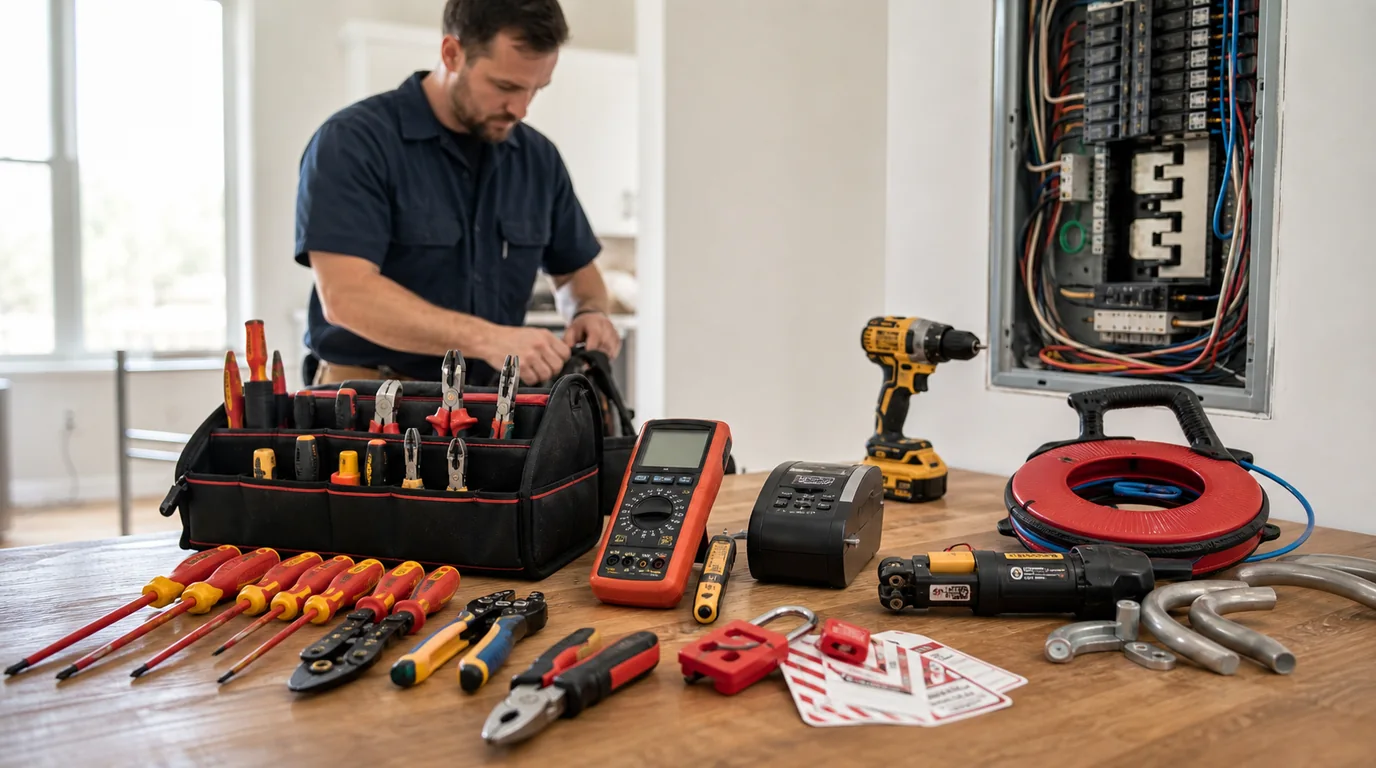
Top 20 Essential Electrician Tools for Pros in 2026
The top 20 essential electrician tools for pros in 2026: safety gear, diagnostic and rough-in tools, EV testing, and business workflow tools.
Key takeaways:
A professional electrician tool kit should support safe testing, accurate installation, efficient troubleshooting, and clear job documentation.
- Build the safety foundation first. Reliable insulated hand tools, voltage testing, lockout equipment, and appropriate PPE come before specialty purchases.
- Match tools to your actual service mix. Residential service, commercial work, conduit, EV charging, and troubleshooting require different equipment.
- Buy specialty tools when the work supports them. Estimate labor saved, rental fees avoided, compatibility, training, calibration, and maintenance before purchasing.
- Organization protects the investment. A consistent storage, inspection, charging, and replacement routine reduces delays and missing equipment.
- Job software is part of the working kit. Photos, notes, estimates, labels, invoices, and service history help the team document what the tools were used to complete.
The wrong tool does more than slow down an electrical job.
It can make the work less safe, less accurate, and harder to explain to the customer.
A dull cutter turns into a bad cable end. A weak tester creates doubt. A missing label printer makes the panel look unfinished. A cheap fish tape turns a normal pull into a frustrating hour inside a wall.
That is why a professional electrician’s kit matters.
The best electricians are not carrying tools just to look prepared. They carry tools that protect them, speed up the job, reduce callbacks, and help them do cleaner work.
This guide breaks down the top 20 essential electrician tools for pros in 2026, with practical notes on what each tool does, when it matters, and how to choose the right one.
Pro tip from the author: “I do not buy tools just because they look impressive. I ask one question first: will this tool make the job safer, faster, cleaner, or easier to prove?”
Quick Answer: What Tools Should a Professional Electrician Have?
A professional electrician should have safety tools, hand tools, testing equipment, layout tools, rough-in tools, pulling tools, labeling tools, and business workflow tools.
Here is the short version:
| Category | Essential tools |
|---|---|
| Safety | Insulated screwdrivers, LOTO kit, torque screwdriver |
| Hand tools | Wire strippers, electrician pliers |
| Testing | Thermal imaging multimeter, circuit analyzer, voltage tester |
| Inspection | WiFi inspection camera |
| Rough-in | Impact driver, conduit bender, knockout tool, cable cutter, hole saws |
| Layout and pulling | 360 laser, powered fish tape, magnetic wire puller |
| Identification | Portable label printer |
| Modern work | EV charger test adapter, LED and driver tester |
| Business workflow | Scheduling, invoicing, inventory, and job management software |
If you are an apprentice, start with safety, hand tools, and basic testing gear.
If you are a contractor or lead electrician, invest more heavily in diagnostic tools, layout tools, and workflow systems. Those are the tools that help you finish work faster and document it better.
1. Insulated Screwdrivers
Insulated screwdrivers are a basic safety tool.
They are designed to reduce shock risk when working around electrical systems. A professional set should include common flathead and Phillips sizes, plus cabinet-tip drivers for panel work and tight electrical devices.
Look for:
- 1,000V-rated insulation
- comfortable grips
- clear size markings
- durable tips
- a storage case or roll
Cheap screwdrivers can round screws, slip in terminals, and wear out quickly.
That matters when you are working in panels, devices, disconnects, and fixtures all day.
2. Wire Strippers
Wire strippers save time and protect conductors.
A good stripper removes insulation cleanly without nicking copper. That sounds small, but damaged conductors can create weak connections and callbacks.
For daily work, choose strippers that handle the wire sizes you use most often.
Common features to look for:
- solid and stranded wire markings
- sharp stripping holes
- comfortable handles
- bolt-cutting slots
- looping holes
- spring-assisted opening
Example:
If you mostly work residential service, a compact stripper for common branch-circuit sizes may be enough. If you work commercial jobs, you may need heavier-duty strippers and cable tools.
3. Electrician Pliers
Electrician pliers are the tools you reach for constantly.
They grip, twist, pull, cut, bend, and shape wire. Many electricians carry more than one type because no single plier handles every task well.
Useful pliers include:
- lineman’s pliers
- needle-nose pliers
- diagonal cutters
- multi-function installation pliers
- non-conductive wire-handling pliers
Choose pliers with strong cutting edges and handles that do not punish your hands after a long day.
Pro tip from the author: “I care more about how pliers feel after six hours than how they feel in the store. Comfort matters when the tool is in your hand all day.”
4. Torque Screwdriver
A torque screwdriver helps tighten electrical connections to the correct specification.
That matters because loose connections can overheat, and overtightened connections can damage terminals or equipment.
A torque screwdriver is especially useful for:
- breakers
- lugs
- panels
- disconnects
- control equipment
- EV charger installations
Look for a tool with clear torque settings, a comfortable grip, and calibration support.
If your work involves inspections or commercial jobs, a torque screwdriver can also help show that connections were tightened properly.
5. Lockout/Tagout Kit
A lockout/tagout kit helps prevent someone from re-energizing a circuit or piece of equipment while work is happening.
It is one of the most important safety tools in a professional kit.
A basic LOTO kit may include:
- padlocks
- breaker lockouts
- tags
- hasps
- plug lockouts
- a storage pouch or case
Use it whenever the work requires controlling hazardous energy.
Do not treat LOTO as paperwork. It is a practical step that protects the person doing the work.
6. Thermal Imaging Multimeter
A thermal imaging multimeter combines electrical measurement with heat detection.
That is useful because electrical problems often show up as heat before they fail.
Use it to check:
- overheating breakers
- loose connections
- overloaded circuits
- failing components
- hot spots in panels
- equipment before shutdown
This type of tool is especially helpful for troubleshooting because it gives you visual evidence.
Example:
A customer says a breaker panel “smells hot sometimes.” A standard meter may not tell the whole story. A thermal tool can help identify the warm connection or overloaded area without guessing.
7. Smart Circuit Analyzer
A circuit analyzer or circuit tracer helps identify circuits, breakers, opens, shorts, and wiring paths.
It is useful when panels are poorly labeled or when old wiring does not match what the customer expects.
A good analyzer can save a lot of time on:
- troubleshooting
- remodels
- commercial service calls
- circuit mapping
- breaker identification
- hidden wiring problems
The best value is not just speed. It is confidence.
When you can identify the circuit correctly, you reduce wasted time and avoid unnecessary wall damage.
8. Non-Contact Voltage Tester
A non-contact voltage tester is one of the first safety tools many electricians carry.
It helps check for voltage before touching conductors or devices.
It should not replace a proper meter when a full test is needed, but it is useful as a quick first check.
Look for:
- clear audible alerts
- bright visual alerts
- durable housing
- pocket clip
- good low-light visibility
- CAT rating appropriate for your work
Use it as part of a safe testing process, not as your only proof.
9. WiFi Inspection Camera
A WiFi inspection camera, or borescope, helps you see inside walls, ceilings, crawlspaces, and other tight areas.
This tool can prevent unnecessary holes and help explain problems to customers.
Use it for:
- checking wall cavities
- finding obstructions
- inspecting conduit paths
- locating hidden damage
- documenting before-and-after work
Example:
If a wire pull keeps hitting an obstruction, an inspection camera can help you see what is blocking the path instead of cutting blindly into drywall.
Pro tip from the author: “I like tools that help me show the customer what I am seeing. A photo or video from inside a wall can make the repair decision much easier.”
10. Hydraulic Impact Driver
An impact driver is a daily-use tool for many electricians.
A hydraulic impact driver can reduce noise and vibration compared with a standard impact, which matters in occupied homes, offices, and retail spaces.
Use it for:
- driving screws
- fastening boxes
- working on fixtures
- assembling equipment
- panel and support work
Look for:
- good battery life
- low vibration
- enough torque
- compact size
- LED lighting
- compatibility with your battery platform
The battery platform matters. If your crew already uses one brand, staying within that platform can reduce battery and charger clutter.
11. Cordless Conduit Bender
A cordless conduit bender can save time and reduce physical strain on larger or repetitive bending work.
It is not needed for every electrician, but it can be valuable for commercial work, batch bending, and larger conduit runs.
Use it when:
- bends need to be repeated
- the job has larger conduit
- manual bending slows the crew
- consistency matters
- the crew is doing long rough-in work
If you only do small residential service jobs, this may not be an early purchase.
If you do commercial rough-in, it can change the pace of the job.
12. Battery-Hydraulic Knockout Tool
A knockout tool creates clean holes for conduit and fittings.
Manual knockout tools work, but battery-hydraulic versions reduce strain and speed up repeated cuts.
Use it for:
- panels
- junction boxes
- control cabinets
- enclosures
- commercial equipment
Look for clean alignment, easy setup, and dies that match the sizes you use most often.
A sloppy hole can make the job look careless. A clean knockout helps the installation look professional.
13. Cordless Cable Cutter
A cordless cable cutter is useful when cutting large cable repeatedly.
It saves hands, wrists, and time.
Use it for:
- service cable
- feeder cable
- large copper or aluminum conductors
- commercial jobs
- panel upgrades
For small residential work, hand cutters may be enough.
For larger jobs, a powered cutter can be worth it because fatigue turns into slower work and rougher cuts.
14. Carbide-Tipped Hole Saws
Hole saws are simple tools, but they matter.
Electricians use them for boxes, conduit paths, recessed lighting, panels, and access holes.
Carbide-tipped hole saws can handle tougher materials and last longer than cheaper bits when used correctly.
Look for:
- sizes you use often
- durable teeth
- easy plug removal
- strong mandrels
- clean cutting
Do not buy only the largest set because it looks complete. Buy the sizes your jobs actually need.
15. Green Beam 360 Laser
A 360 laser helps with layout.
It is useful when installing boxes, fixtures, conduit, panels, lighting, and devices that need to line up cleanly.
Green beams are often easier to see than red beams, especially in bright spaces.
Use it for:
- fixture layout
- outlet height consistency
- conduit alignment
- commercial room layouts
- panel and equipment positioning
Good layout saves rework.
It also makes finished work look sharper.
16. Powered Fish Tape
Fish tape helps pull wire through walls, conduit, and finished spaces.
Powered fish tape can reduce the manual effort on long or difficult pulls.
Use it when:
- pulls are long
- bends are difficult
- the crew does repeated wire fishing
- access is tight
- speed matters
Manual fish tape still has a place. Powered fish tape is most valuable when wire pulling is a regular part of your work.
17. Magnetic Wire Pulling System
A magnetic wire pulling system helps fish wire through finished walls without making extra holes.
It is useful for retrofit work, low-voltage work, smart home installs, and residential upgrades.
Use it for:
- wall fishing
- low-voltage cable
- finished homes
- retrofit lighting
- security wiring
- smart device installs
This tool can save drywall repair and reduce customer frustration.
That makes it valuable even if you do not use it every day.
18. Portable Label Printer
Labeling is easy to skip when the job is rushed.
That is a mistake.
A portable label printer helps create clean, durable labels for panels, wires, devices, and equipment.
Use it for:
- panel schedules
- wire labels
- circuit identification
- disconnect labels
- commercial documentation
- service records
Customers may not notice every perfect connection, but they do notice clean labels and organized panels.
Pro tip from the author: “I see labeling as part of the finished job, not an extra. Clean labels make future service easier and make the work feel more professional.”
19. EV Charger Test Adapter
EV charger work keeps growing.
An EV charger test adapter helps verify that a charger is installed and working correctly.
Use it to check:
- charging station output
- installation safety
- operating modes
- connections
- customer handoff
This is not a beginner tool for every apprentice. It is a specialty tool for electricians who install or service EV chargers.
If EV work is part of your business plan in 2026, testing equipment should be part of the plan too.
20. LED and Driver Tester
LED lighting can create confusing service calls.
The problem may be the driver, fixture, lamp, connection, control, dimmer, or power supply.
An LED and driver tester helps narrow the issue faster.
Use it for:
- commercial lighting service
- retrofit jobs
- fixture troubleshooting
- driver testing
- customer complaints about flicker or failure
This tool is especially useful for electricians who service offices, retail spaces, warehouses, and modern lighting systems.
Bonus: Business Management Software
Software is not a hand tool, but it can be one of the most important tools in an electrical business.
The work does not end when the wire is pulled.
You still need to schedule the job, send the estimate, dispatch the tech, track materials, invoice the customer, collect payment, and follow up.
Business management software can help with:
- scheduling
- dispatching
- estimates
- invoices
- payments
- customer records
- job notes
- inventory
- reporting
- team communication
For a solo electrician, software can reduce admin time.
For a growing company, it can prevent missed calls, lost invoices, double-booked jobs, and material confusion.
What Should Apprentice Electricians Buy First?
An apprentice does not need every advanced tool on this list on day one.
Start with tools that help you work safely and learn the trade.
Good first purchases include:
- insulated screwdrivers
- wire strippers
- lineman’s pliers
- needle-nose pliers
- diagonal cutters
- non-contact voltage tester
- basic multimeter
- tape measure
- level
- flashlight or headlamp
- tool belt or bag
Wait on expensive specialty tools until you know what type of electrical work you will do most often.
Example:
If you work mostly residential service, a magnetic wire pulling system may be more useful than a cordless conduit bender. If you work commercial rough-in, the opposite may be true.
How to Choose Electrician Tools Without Wasting Money
Good tools are expensive, so buy based on your actual work.
Before buying, ask:
- Do I use this type of tool every week?
- Will it make the job safer?
- Will it reduce labor time?
- Will it reduce callbacks?
- Will it help me document work?
- Does it match my battery platform?
- Will it hold up on real job sites?
- Can I replace parts or get it serviced?
A tool that saves 20 minutes on a job you do twice a month may not matter much.
A tool that saves 20 minutes on a job you do every day can pay for itself quickly.
Use this simple formula:
Tool payback = tool cost / monthly labor savings
Example:
A tool costs $600.
It saves 4 labor hours per month.
Your billable labor rate is $100 per hour.
Monthly labor savings:
4 x $100 = $400
Tool payback:
$600 / $400 = 1.5 months
That is an easy tool to justify.
Common Electrician Tool Mistakes
Avoid these mistakes:
- buying advanced tools before basic safety gear
- carrying dull cutters
- using worn insulated tools
- skipping labels
- using a tester you do not trust
- mixing too many battery platforms
- buying tools for jobs you rarely do
- ignoring calibration on measurement tools
- letting the truck become disorganized
- forgetting software and admin tools
The best kit is not always the biggest kit.
The best kit is the one that matches the work you actually do.
Electrician Tool Checklist for 2026
Before upgrading your kit, check:
- Do I have reliable safety tools?
- Are my testers rated for the work I do?
- Are my hand tools comfortable enough for daily use?
- Do my rough-in tools save time?
- Can I document problems clearly?
- Can I label finished work cleanly?
- Do I have tools for EV and LED work if I offer those services?
- Does my software help me schedule, invoice, and track jobs?
- Do I know which tools are actually paying for themselves?
If the answer is no, start with the gap that affects safety, speed, or customer trust the most.
Final Takeaway
The right electrician tools help you work safer, faster, and cleaner.
Start with the basics: insulated tools, wire strippers, pliers, voltage testing, and lockout/tagout gear.
Then build around the work you do most often.
If you handle troubleshooting, invest in better diagnostic tools. If you do rough-in work, invest in tools that reduce fatigue and save hours. If you install EV chargers or modern lighting, add the testing tools that help you verify the work clearly.
Do not build your kit to impress someone else.
Build it to protect your time, your safety, your customers, and your profit.